About / Practice
I like to bend photogrammetry, volumetric capture, computer vision, and game technologies toward stories of place, memory, power, and ecology.
I often begin with a place or an experience that conventional cameras cannot capture, then find the forms and tools it needs.
My work begins with time spent in a place. I record conversations, images, sounds, archives, and the systems that shape what can be seen there. I try to apply the form that fits the subject. Sometimes one subject needs several approaches.
Making things strange
The term I mean is ostranenie, usually translated as defamiliarization: making familiar things strange so they can be seen anew. You look at the world, your politics, or your life with a little fascination, curiosity, or distance. Things that seemed immutable or obvious are no longer taken for granted.
I discovered this while training as a photographer. You start to internalize the photographic frame as you walk around. I would imagine how the felt, immersive, three-dimensional world in front of me would look from one angle, flattened and compressed through a particular lens. Having to imagine the point of view imposed by the apparatus made me look differently.
I developed a very similar experience when I started 3D scanning. Instead of rectangular compositions, I began to see shapes and topology as beautiful. A texture or sculptural form could feel promising as something to capture. I began to call that quality scanogenic.
There is another part of the process that I love: the delay. You go out with an intention, then the intention has time to simmer, evolve, or haunt your mind before you see what was captured. That happens in the darkroom, and it happens again while a scan or photogrammetric model is processed. I find that cycle intoxicating.
In many projects, it also means looking away from the most obvious entry point. The center of a fight is already very well explored. I was more interested in preparation and recovery. There is ample territory outside the white-hot center of a story.
Technical images
I work with tools built to measure, model, track, or control: 3D scanners, computer vision, geographic data, game engines, surveillance systems, robotics, and maps.
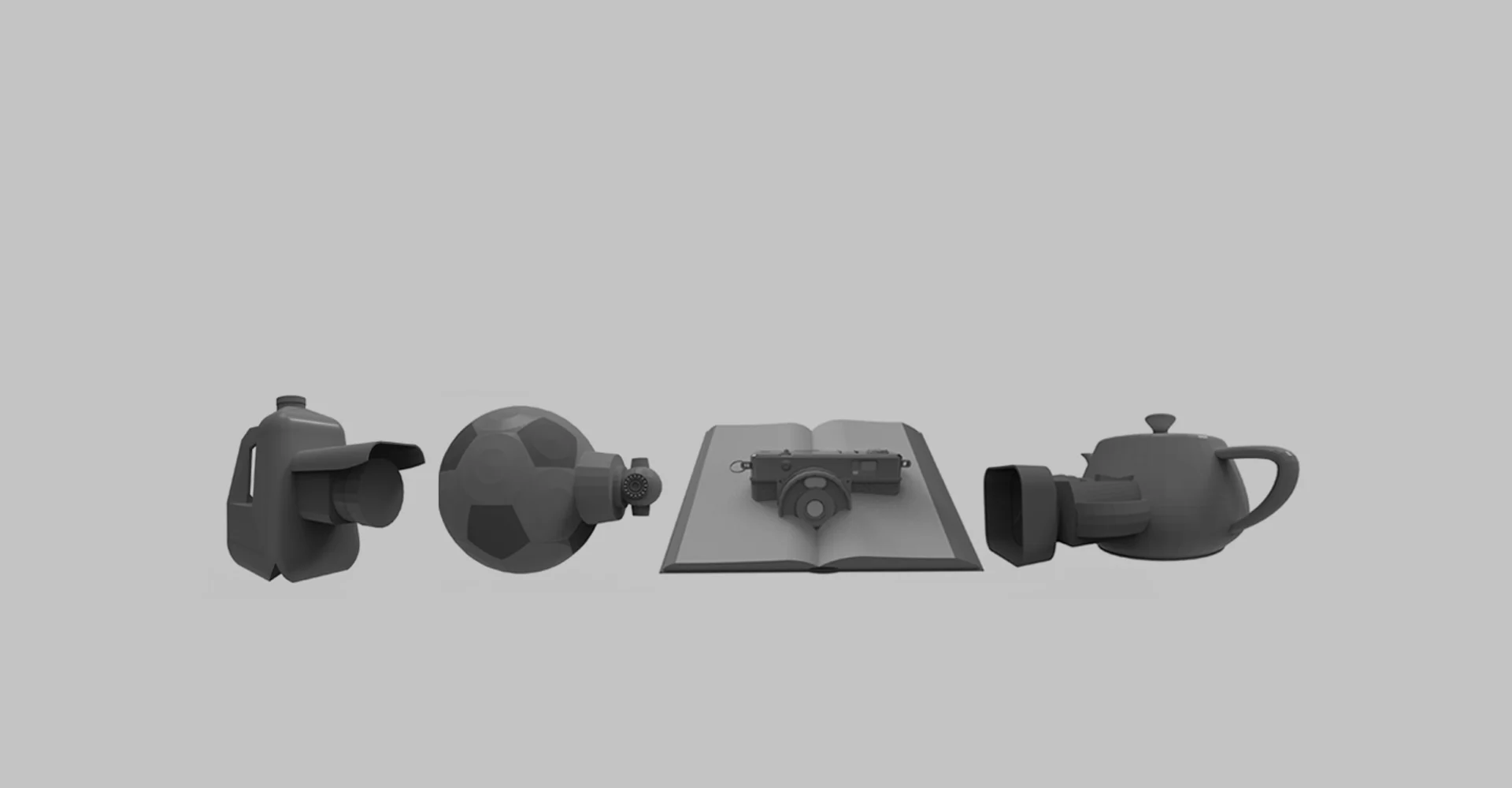
In the Camera of the Future workshop, I would ask students to name the most common camera. They would suggest phones, consumer cameras, or security cameras. At the time, I believed it was the optical mouse: a tiny, very close camera trained on the texture of the surface beneath it. Technical cameras are already operating around us in forms we do not necessarily recognize as cameras.
Graphs, maps, scans, and other technical images can appear to be the world itself rather than an interpretation of it. I am interested in misapplying tools of capture: questioning their claim to perfect accuracy while making images their designers did not anticipate.
The experimental photographer in Vilém Flusser's Towards a Philosophy of Photography tries to play against the apparatus, putting something into the image that was not already inscribed in its program. I find that useful. A tool defines a possibility space. Modification becomes expressive, and sometimes required, when the image, story, or encounter I want lies outside that space. I modify the tool, and the modification itself becomes expressive.
At Scatter, we made that an intentional practice: imagine what we wanted to create, then reverse-engineer the tools that would need to exist. I still work that way.
I work in immersive media and remain critical of it. There is a theme in VR about evading the world and checking out of real life. I use these systems to return to a place, hold several perspectives at once, or inspect how an image was made.
What makes it documentary
What makes something documentary when it is not a film? For me, one part of the answer is the truth claim the work makes. I think documentary sits somewhere between journalism and pure fiction. It is an interpretive form grounded in the real world and the stories of other people. Ideally it is humble about the director's subjectivity and foibles.
I want someone encountering the work to understand that a real person spoke from experience and that an environment existed. The work should maintain a certifiable relationship between its claims and the world. Where something is interpretive—a person describing an experience, for example—that should be clear. The material should be situated more or less honestly.
I accept those constraints and still want the work to be imaginative, surreal, or strange. A documentary does not have to be a linear film. Interactive work can represent a complex system by allowing someone to enter it, make choices, and see what those choices do. It can use games, staging, metaphor, and visualization while retaining a documentary sensibility.
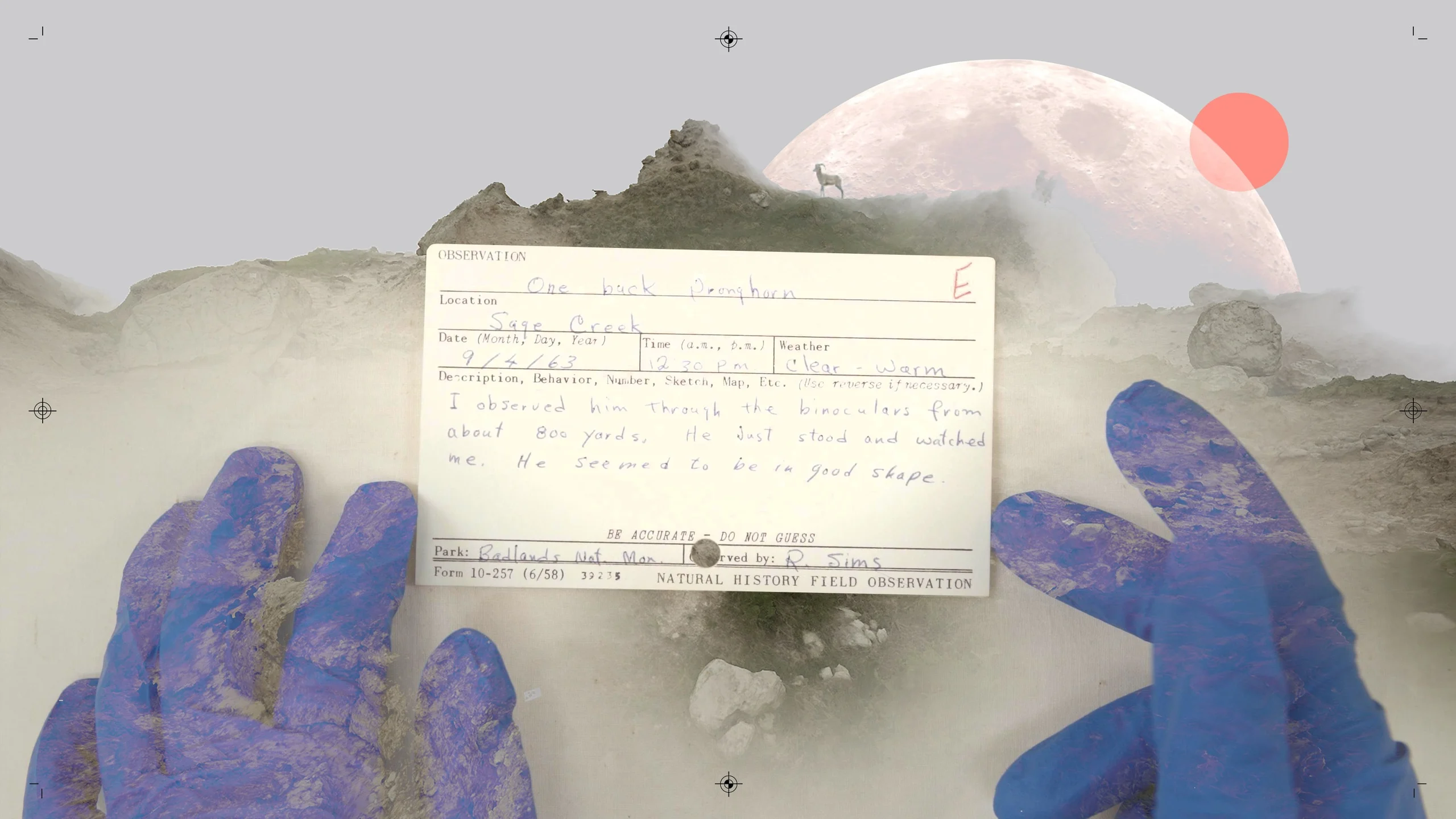
My virtual environments begin with photographs, films, scans, maps, field recordings, and testimony. On In Restless Dreams, I inferred a room from a roll of 35mm photographs. For Truth or Consequences, we rebuilt locations from handheld documentary footage. For Strata, over 5,000 photographs became a fifty-meter patch of the Badlands. The scan is another interpretation, and I am responsible for what I decide to hide or show.
Building the tool a story requires
Early RGB-D rigs paired a color camera with a Kinect sensor. The cameras had to stay aligned, so I designed mounts, published plans, and sold assembled kits. That work led from RGBDToolkit to Depthkit, a volumetric-capture system used by artists and filmmakers around the world.
Making the tool adds another layer to the art practice. When someone uses a tool I helped create to make something I could not have imagined, I think of them as a faint collaborator. Their work remains their own. In a distant sense, it also extends the practice beyond the things I made with the tool myself.
Production kept changing the system. Blackout needed recorded passengers to hold together while a viewer moved through a subway car. Zero Days VR placed a live depth image of the viewer across a virtual table. The Changing Same used a live composite so actors, camera crew, and remote directors could share a virtual location.
One place, several forms
My current practice centers on Topography, a multi-format documentary project I lead with filmmaker Hannah Jayanti. We spend time with people, landscapes, archives, images, and sounds, then ask what form the material needs.
Badlands is a feature documentary in production. Strata uses related fieldwork in a live performance, an installation in development, and a game in development. A recording made for the film can enter the performance; a scanning tool can become the basis of an installation. The forms produce material for one another.
I am also an unrepentant tinkerer. I love creating forensic 3D reconstructions from incomplete archives: old or fragmented records, real or imaginary. I love coaxing spatial information out of unstructured piles of visual material.
I want the site to leave room for sketches. Untitled Landscapes is not a completed project. It is a group of scans and debug images that I may return to as deliberately over-wide panoramas. Putting a sketch here does not make it finished. It gives me a reason to elaborate it, extend it, or complete it.
First person
Essays, notes, and interviews in my own words
Writing and notes
Conversations, talks, and profiles
On camera affordances, modifying tools, and Flusser’s experimental photographer. The excerpt begins at 16:42.
Open on YouTube ↗- Voices of VR Podcast · 2021#978: Democratizing Volumetric Capture with Scatter's Depthkit↗
- Art in America · 2020Telling Stories with Volumetric Filmmaking↗
- The Splash · 2020The Splash — A chat with Hannah Jayanti and Alexander Porter↗
- Filmmaker Magazine · 2019From All Angles: The Groundbreaking Volumetric Filmmaking of Scatter↗
- Research VR Podcast · 2018Volumetric Video, Depth Cams, and Filmmaking using Depthkit↗
- BBC Digital Planet · 2018When Virtual Reality Competes With Reality↗
- Engadget · 2017Blackout | VR Experience | Tribeca 2017↗
- BBC Future · 2016Virtual reality: The hype, the problems and the promise↗
- New Yorker Radio Hour / WNYC · 2016Virtual Reality: The Wearable Movie↗
- Unity Blog · 2015Exquisite City — Unity Blog interview↗
Current focus